
Capturing value
The third wave of marketing transformation is under way – are you prepared?
Marketing AI has moved beyond scattered software adoption. The next advantage comes from rewiring the operating model itself.

Marketing AI has officially evolved past the era of scattered software adoption into a third wave of structural transformation. With CEO expectations mounting and 94% of CMOs reporting a significant spike in accountability, the mandate has shifted from testing isolated software to rewiring operational strategy.
To understand where top-performing teams are going, it helps to look at where we’ve been.
- The initial wave of AI spending went to disconnected tools—stand-alone content generators, chatbots, and basic personalisation engines.
- The second wave established the necessary foundations, creating connective tissue across data, measurement, and talent.
- Now, the third wave shifts focus to the core operating infrastructure itself. Forward-thinking leaders are no longer asking which point-solution tool to buy, but rather what overarching framework will allow their AI models, agents, and workflows to operate cohesively.
Three areas of execution
Leading organisations are driving this shift by fundamentally altering three areas of execution.
- First, they are redesigning the entire customer journey to compete at every touchpoint disrupted by large language models, from initial discovery through to conversion.
- Second, they are actively rewiring the organisation by redefining internal roles, upskilling teams, and realigning agency relationships.
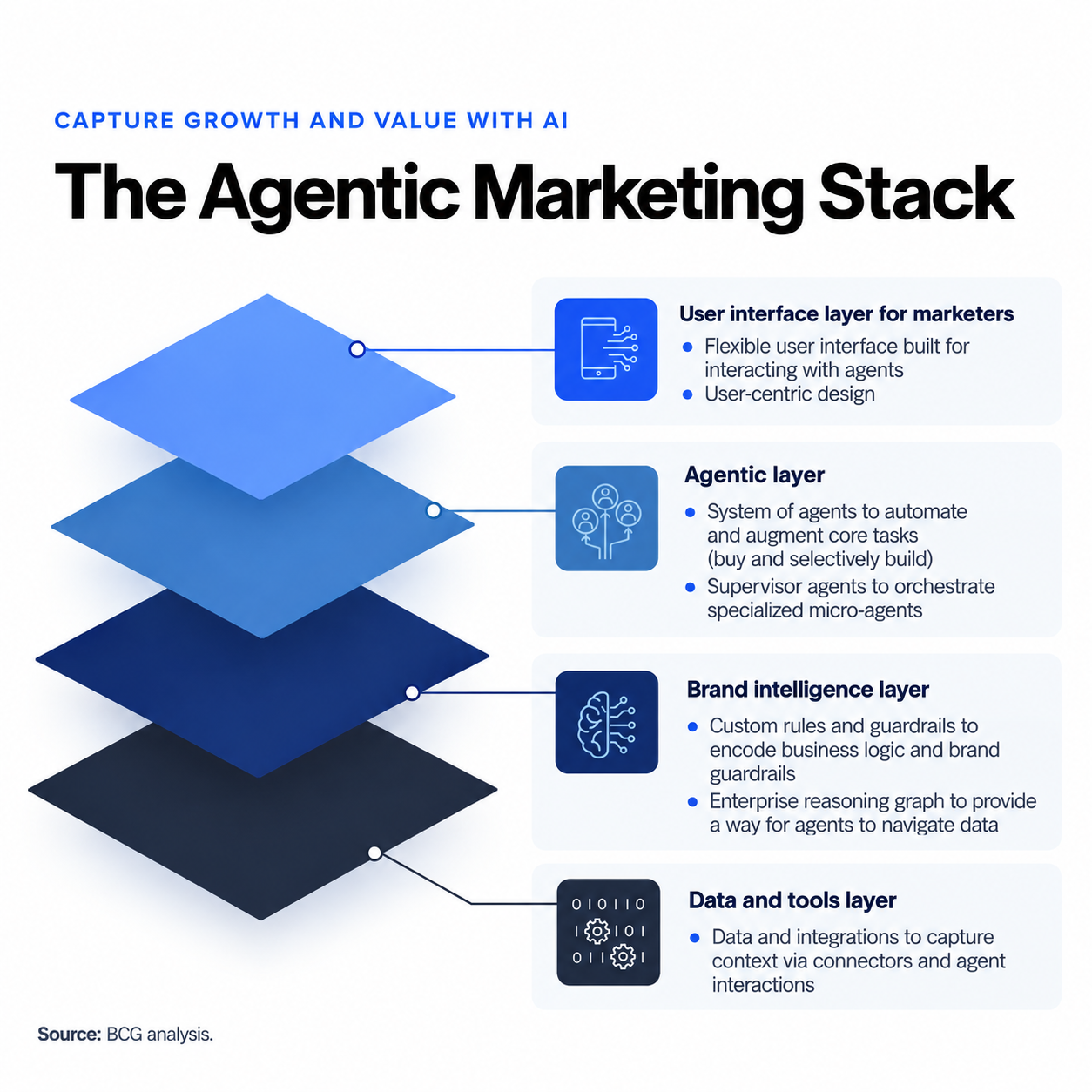
- Finally, they are building modern agentic tech stacks anchored in deep brand intelligence and practical operational workflows.
Beyond cost efficiency
The commercial impact of this shift extends far beyond baseline cost-cutting. While efficiency remains top of mind for many executive teams, market leaders are balancing top-line revenue growth with execution speed. Early movers report 20% to 30% gains in cost efficiency, a 3x increase in marketing ROI, and a 10x reduction in campaign cycle times. This is already translating to the bottom line, with 31% of B2C CMOs and 20% of B2B CMOs confirming that agentic transformation is generating measurable revenue.
The next standard of growth
Ultimately, winning in this next era requires a complete overhaul of the classic marketing operating model. CMOs who build agile, intelligence-driven organisations positioned to excel in agent-mediated environments will define the next standard of growth.
Interested in learning more? Speak to us.
Explore more